Displaced Emperors
Relational Architecture 2
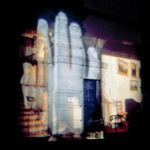
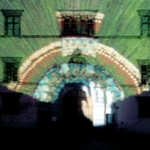
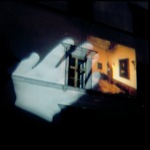
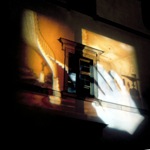
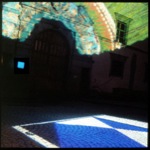
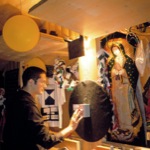
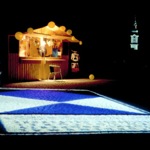
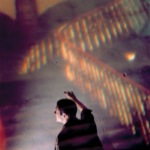
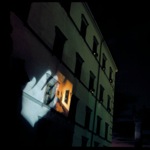
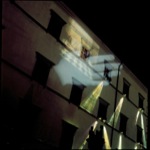
"Displaced Emperors" (Relational Architecture 2) was an interactive installation that used an "architact" —architecture meets haptics— interface to transform the facade of the Habsburg Castle in Linz, Austria. Wireless 3D sensors calculated where participants pointed to on the façade and a large animated projection of a hand was projected at that location. As people on the street "caressed" the building, they could reveal the interiors of the Habsburg residence in Mexico City, Castillo de Chapultepec. In addition, for ten schillings, participants could press the "Moctezuma button" and trigger a temporary postcolonial override consisting of a huge image of the Aztec head-dress that is kept at the Museum für Völkerkunde in Vienna, followed by a parade of images of jewels from the Austrian-Hungarian Empire, set to music by Toña la Negra.
Displaced Emperors departs from the supposition that cultural property is cultural poverty. As an architectural mise-en-abîme, the project supports the idea of perpetration of culture instead of calls for its vampiric preservation.
Displaced Emperors departs from the supposition that cultural property is cultural poverty. As an architectural mise-en-abîme, the project supports the idea of perpetration of culture instead of calls for its vampiric preservation.
General info
Spanish name:
Emperadores Desplazados
Year of creation:
1997
Technique:
A 7 kW Xenon projector with robotic scrollers and Duraclear transparencies, wireless 3D tracking system, sound system
Dimensions:
Projection area: 800 m2
Keywords:
Credits
- Programming, Audio and Hardware: Will Bauer
- Production Assistance: Susie Ramsay, Daniel Rivera and Patricia Maie
Bibliography
- "Pseudomatismos, de Rafael Lozano-Hemmer muestra la luz en el arte." Zona Franca, 30 Oct. 2015. San Miguel de Allende, México, 2015. (español) (Websites)
 "Rafael Lozano-Hemmer." Rue Descartes, Vol. 57, July 2007. Paris, France. (english) (Magazines)
- "Moi et ma circonstance." Musée des Beaux Arts de Montéal, 1999. Montréal, Québec, Canada. (english and français) (Books)
- Alm, David. "Cities of light - Rafael Lozano-Hemmer’s architectural revisions." RES, vol. 4, no. 3, May / June, 2001. (english) (Magazines)
 Alonso, Rodrigo, Rafael Lozano-Hemmer and Paul Waelder. "Espejos de Mexico." Fundación PROA, PROA, 1 Sep. 2024, 97-121. Buenos Aires, Argentina. (español) (Books)
- Druckrey, Timothy. "Relational Architecture: the work of Rafael Lozano-Hemmer." Debates & Credits. Media / Art / Public Domain, 2003. Amsterdam, Netherlands. (english and deutsch) (Books)
- Fernández, Maria. "Illuminating Embodiement: Rafael Lozano-Hemmer's Relational Architectures." Architectural Design vol. 77, no. 4, July/august, July 2007. London, United Kingdom. (english) (Magazines)
- Fernández, María. "Transnational culture at the End of the Millennium.." Cosmopolitanism in Mexican Visual Culture, University of Texas Press, 2014. Austin, Texas, United States. (english) (Books)
- Flores, Tatiana. "The Historical (Self-) Conciousness." ArtNexus, Vol.7, No.71, May 2010. Madrid, Spain. (english) (Magazines)
- Lozano-Hemmer, Rafael. "Displaced Emperors, Relational Architecture #2." FleshFactor, Ars Electronica, 1997. Linz, Austria. (Books)
- Massumi, Brian. "Strange Horizon: Buildings, Biograms and The Body Topologic." Architectural Design, 1999. London, United Kingdom, 2011. (english) (Magazines)
- Ozaki, Tetsuya. "Rafael Lozano-Hemmer." GEO Japan, vol. 6, no. 53, June 1998. (japanese) (Magazines)
- Paul, Christiane. "Digital Art." 2003. London, United Kingdom. (english) (Books)
- Ranzenbacher, Heimo. "Metaphors of Participation." Takeover ‒ who's doing the art of tomorrow. ARS Electronica 2001, 2001. Vienna, Austria. (english) (Books)
- Schnabel, Jeff. "Transforming the Public Realm with Projected Light." Arcade Magazine, 20 Dec. 2012. Seattle, Washington, United States, 2013. (english) (Magazines)
- Stocker, Gerfried and Schöpf, Christine. "Relational Architecture no2 – Displaced Emperors." Flesh Factor ‒ informationsmaschine mensch, 1997. Vienna, Austria. (english and deutsch) (Books)
- Walder, Paul. "Rafael Lozano-Hemmer: fragmentos de un código fuente. Rafael Lozano Hemmer: fragments of a source code." Art.es, 2012. Spain. (english and español) (Magazines)
- Wilson, Stephen. "Rafael Lozano-Hemmer." Information Arts ‒ Intersections of Art, Science, and Technology, 2002. Cambridge, United Kingdom. (english) (Books)
Photo Library (click to expand)
1997 - Ars Electronica Festival, Linz, Austria