Black Hole
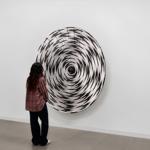
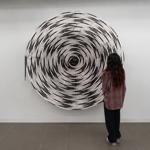
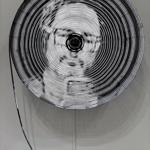
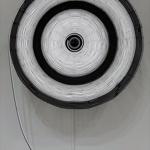
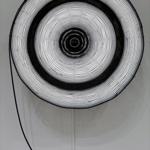
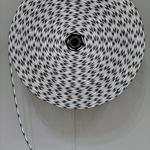
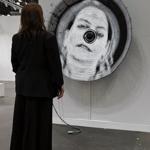
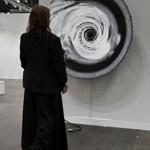
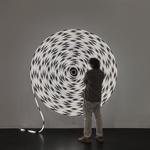
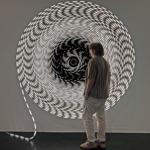
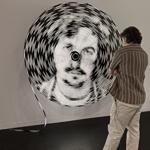
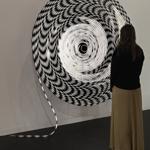
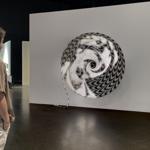
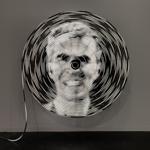
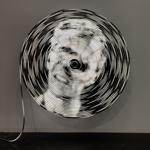
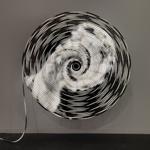
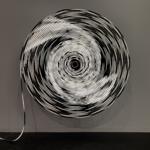
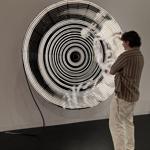
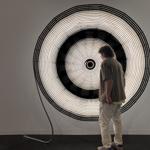
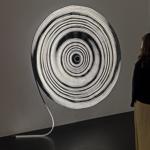
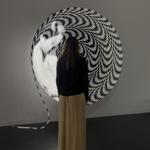
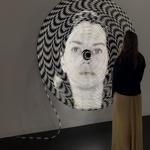
“Black Hole” is a wall-mounted concave spiral made with a single continuous line of white light embedded within a black tubular diffuser, with a panoptic surveillance camera positioned at its centre. The piece displays a continuous vortex of light being absorbed into the black camera dome, intermittently revealing the portraits of viewers looking at the work before drawing them into the flow.
Shaped like a satellite dish to evoke directional tuning, the central camera dome recalls cinematic cyclopes such as HAL from 2001: A Space Odyssey. The spiral itself is an ancient figure of accumulation and collapse: matter drawn inward, energy concentrated toward a vanishing point. Here, that point is an industrial camera equipped with face-detection algorithms that register and incorporate viewers into the vortex. Unlike surveillance systems that archive and police everyday life, “Black Hole” continuously erases the information it gathers as each portrait disappears into the spiral. The work thus stages both a memento mori and an anti-metric gesture: a visualization of disappearance rather than retention.
To look at “Black Hole” is also to be looked at—catalogued, measured, and returned to a system that can recognize only what it has been trained to see. The facial analysis at its core carries the accumulated biases of training data, the blind spots of its designers, and the political economy of its deployment. What the camera captures is never simply a viewer, but a subject filtered through layers of computational interpretation. In this sense, “Black Hole” extends a lineage running from TV Buddha by Nam June Paik—where a sculpture watches its own live image in an ouroboros of analog vision—through the computational turn that transformed the mise en abyme into something no longer frictionless. Where early CCTV artworks often staged an endless regression of watching and being watched, “Black Hole” introduces the recursive logic of contemporary machine vision: the artwork analyzes the observer who analyzes the artwork, and neither emerges unchanged.
For precedents and inspiration on this work please check this document.
Shaped like a satellite dish to evoke directional tuning, the central camera dome recalls cinematic cyclopes such as HAL from 2001: A Space Odyssey. The spiral itself is an ancient figure of accumulation and collapse: matter drawn inward, energy concentrated toward a vanishing point. Here, that point is an industrial camera equipped with face-detection algorithms that register and incorporate viewers into the vortex. Unlike surveillance systems that archive and police everyday life, “Black Hole” continuously erases the information it gathers as each portrait disappears into the spiral. The work thus stages both a memento mori and an anti-metric gesture: a visualization of disappearance rather than retention.
To look at “Black Hole” is also to be looked at—catalogued, measured, and returned to a system that can recognize only what it has been trained to see. The facial analysis at its core carries the accumulated biases of training data, the blind spots of its designers, and the political economy of its deployment. What the camera captures is never simply a viewer, but a subject filtered through layers of computational interpretation. In this sense, “Black Hole” extends a lineage running from TV Buddha by Nam June Paik—where a sculpture watches its own live image in an ouroboros of analog vision—through the computational turn that transformed the mise en abyme into something no longer frictionless. Where early CCTV artworks often staged an endless regression of watching and being watched, “Black Hole” introduces the recursive logic of contemporary machine vision: the artwork analyzes the observer who analyzes the artwork, and neither emerges unchanged.
For precedents and inspiration on this work please check this document.
General info
Spanish name:
Agujero Negro
Year of creation:
2026
140 cm
Technique:
LED lights, panoramic surveillance camera, custom diffuser, metal support, computerised surveillance system, custom-made software
Power:
1,500W on 110-240V
Room conditions:
The artwork is wall-mounted using a wall bracket secured with six screws into solid wood backing, with the frame locked in by a hanging clip and additionally secured to the wall through its flat back frame. The piece requires internet access.
Dimensions:
140 cm diameter, 37 cm protrusion from the wall
Weight:
Approximately. 90 kg
Edition:
6 Editions, 1 AP
224 cm
Technique:
LED lights, panoramic surveillance camera, custom diffuser, metal support, computerised surveillance system, custom-made software
Power:
2,000W on 110-240V
Room conditions:
The piece requires internet access and is hung on the wall using its 15 radial aluminium braces.
Dimensions:
224 cm diameter, 37 cm protrusion from the wall
Weight:
Approximately 70 kg (40 kg in linear lights, 30 kg in electronics and metal)
Edition:
3 Editions, 1 AP
Collectors:
private collectors
Exhibitions
- Armory Show, Galería Max Estrella, Jacob K. Javits Convention Center, New York City, New York, United States, 2026.
- Panoptic Chiasma, Gallerists collaboration (bitforms Gallery, Galería Max Estrella), Zero 10 by Art Basel, Basel, Switzerland, 2026.
Credits
- Software: Hugo Daoust, David Robert
- Hardware: Sebastien Dallaire, William Sutton, Stephan Schulz
- Production: Sebastien Dallaire, William Sutton, Stephan Schulz, Hugo Daoust, Emily Green
Photo Library (click to expand)
2026 - Armory Show, Galería Max Estrella, Jacob K. Javits Convention Center, New York City, New York, United States








2026 - Panoptic Chiasma, Gallerists collaboration (bitforms Gallery, Galería Max Estrella), Zero 10 by Art Basel, Basel, Switzerland
2026 - Antimodular Studio, Montréal, Canada