Babbage Lovelace
Text Stream 5
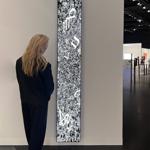
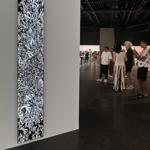
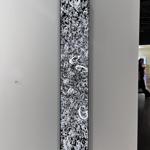
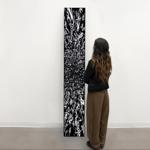
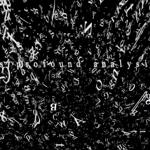
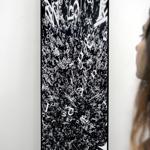
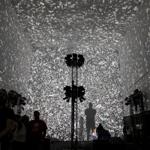
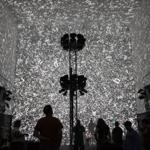
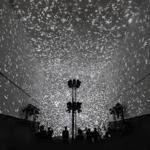
Babbage Lovelace is a generative animation made with the collected writings of English polymath Charles Babbage, the designer of the first programmable computer, and his collaborator Ada Lovelace, widely recognized as the author of the first published computer program.
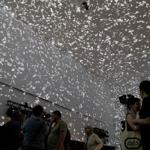
In this work, letters drawn from both authors' texts drift across the screen in an expanding stream, governed by fluid dynamic patterns that are never repeated. Dispersed like the parts of a mechanism suspended before assembly, the typography moves slowly until it briefly coheres into sentences—thought surfacing from noise—before dissolving back into its elements. Language here behaves as Lovelace imagined the engine might: as something capable of operating upon symbols whose meaning exceeds the instructions that produce them.
The piece is part of the Text Stream series of works by Lozano-Hemmer, which are inspired in part by the work of French Symbolist poet Stéphane Mallarmé, for whom the arrangement of language on the page was itself a form of meaning, and by Antropofagia, the conceptual practice associated with the Brazilian Tropicália movement, which proposed that ideas are transformed—rather than merely transmitted—in the act of being absorbed and re-expressed. In Babbage Lovelace, two Victorian minds are fed back through the very machine their words helped invent.
Edition of 6+1AP for a single display presentation, and 1/1+1AP for a treatment version designed for large projection or multiscreen configurations.
In this work, letters drawn from both authors' texts drift across the screen in an expanding stream, governed by fluid dynamic patterns that are never repeated. Dispersed like the parts of a mechanism suspended before assembly, the typography moves slowly until it briefly coheres into sentences—thought surfacing from noise—before dissolving back into its elements. Language here behaves as Lovelace imagined the engine might: as something capable of operating upon symbols whose meaning exceeds the instructions that produce them.
The piece is part of the Text Stream series of works by Lozano-Hemmer, which are inspired in part by the work of French Symbolist poet Stéphane Mallarmé, for whom the arrangement of language on the page was itself a form of meaning, and by Antropofagia, the conceptual practice associated with the Brazilian Tropicália movement, which proposed that ideas are transformed—rather than merely transmitted—in the act of being absorbed and re-expressed. In Babbage Lovelace, two Victorian minds are fed back through the very machine their words helped invent.
Edition of 6+1AP for a single display presentation, and 1/1+1AP for a treatment version designed for large projection or multiscreen configurations.
General info
Year of creation:
2019
Shadow Box
Technique:
Computer, display, custom-made software
Room conditions:
Low lighting required
Dimensions:
Variable. 85.6 inch diagonal, 216cm x 35cm x 8cm
Weight:
20.5 kg
Keywords:
Edition:
6 Editions, 1 AP
Treatment
Technique:
Computer, projector(s), custom-made software
Room conditions:
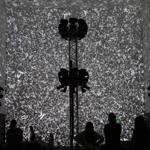
Low lighting requirement. The room can be as small as 6x6m or as large as 12x36m so long as enough projectors are provided.
Dimensions:
Variable
Additional info:
Can take over a single wall or all four walls in a room.
Keywords:
Edition:
1 Edition, 1 AP
Collectors:
Musée des beaux-arts de Montréal
Exhibitions
- Armory Show, Galería Max Estrella, Jacob K. Javits Convention Center, New York City, New York, United States, 2026.
- Panoptic Chiasma, Gallerists collaboration (bitforms Gallery, Galería Max Estrella), Zero 10 by Art Basel, Basel, Switzerland, 2026.
- Atmospheric Memory, Manchester International Festival, Powerhouse Ultimo - Museum of Applied Arts and Science, Sydney, Australia, 2023.
- Rafael Lozano-Hemmer: Atmospheric Memory, Manchester International Festival, University of North Carolina, Chapel Hill, North Carolina, United States, 2021.
- Rafael Lozano-Hemmer: Atmospheric Memory, Manchester International Festival, Manchester, United Kingdom, 2019.
Credits
- Programming and Design: Kitae Kim
- Production Assistance: Sarah Amarica, Karine Charbonneau, Miguel Legault, Caroline Record, Stephan Schulz, Tegan Scott, Guillaume Tremblay
Bibliography
 Bulut, Zeynep. "Building a Voice: Sound, Surface, Skin." Goldsmiths Press, 12 Dec. 2024, 212-233. London, United Kingdom. (english) (Books)
Photo Library (click to expand)
2026 - Panoptic Chiasma, Gallerists collaboration (bitforms Gallery, Galería Max Estrella), Zero 10 by Art Basel, Basel, Switzerland
2026 - Antimodular Studio, Montréal, Canada
_t.jpg)
_t.jpg)
_t.jpg)
_t.jpg)
_t.jpg)
_t.jpg)